
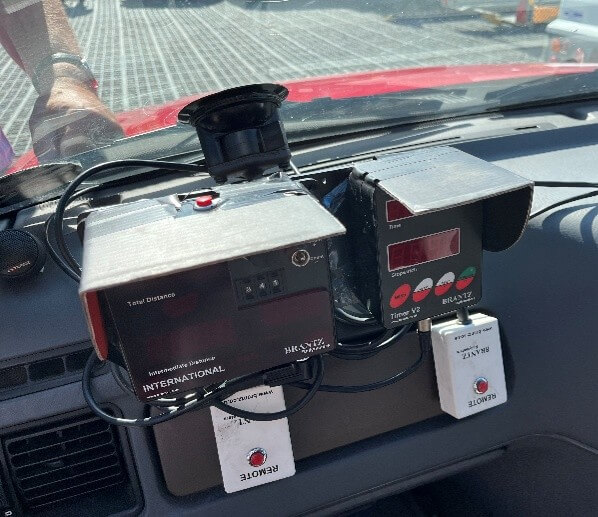
As in-car technology and safety equipment continue to evolve, it’s important that inspections remain consistent and in line with the National Competition Rules (NCR) and FIA guidance. Below are two reminders for Scrutineers.
Inspection of In-Car Information Devices

A reminder that all in-car information devices must be installed in accordance with the requirements of NCR Chapter 7, Appendix 2, Articles 22.17 and 22.18.
Information devices, including – but not limited to – data loggers, displays, instrumentation, communication systems (where permitted) and trip computers, are increasingly common across all disciplines. During scrutineering, particular attention should be given to the method of installation and the potential risk these devices may present to the vehicle occupants.
When carrying out inspections, Scrutineers should ensure that:
- All devices are securely mounted using a suitably robust mechanical fixing capable of withstanding the loads and vibration encountered during competition
- Mountings do not present sharp edges, protrusions or other hazards within the vicinity of the driver’s or passenger’s body or helmet
- Where practicable, a secondary means of retention is fitted to minimise the risk of a device becoming detached in the event of a collision
- Suction mounts are not acceptable as the primary means of attachment
 Whilst many commercially available mounting systems are marketed for motorsport use, acceptance should be based on compliance with the National Competition Rule rather than manufacturer claims. Where the security of a mounting or the risk it presents to occupants is in doubt, competitors should be required to rectify the installation before the vehicle is accepted for competition.
Consistent application of these requirements will help reduce the risk of detached equipment and cockpit injuries, whilst ensuring a uniform approach to scrutineering across all disciplines.
Frontal Head Restraint (FHR) Devices – Inspection of Additional Padding and Modifications
Scrutineers are also reminded to carefully consider any additional padding or non-standard modifications fitted to FIA-homologated Frontal Head Restraint (FHR) devices, with reference to the FIA Standard Guidelines for Frontal Head Restraint Devices.
The FIA homologation requirements specify that, with the driver seated and the harness correctly tensioned, the shoulder harness should compress the FHR padding to a thickness of approximately 1.5 mm. Additional padding may prevent the device from meeting this requirement and should therefore be considered when assessing compliance.
While the FIA guidance does not set out a specific method for securing recommended replacement padding, it places significant emphasis on protecting the friction rubber surface beneath the shoulder straps. This is a key functional part of the device and should remain free from damage or obstruction.
Any FHR fitted with additional padding or non-standard fixings should therefore be assessed carefully. Where cable ties or similar retention methods pass across the friction surface, consideration should be given to whether they could affect the function of the material or lead to accelerated wear. These arrangements may affect the device’s continued compliance with its FIA homologation.
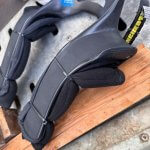
As with any homologated safety equipment, FHR devices should be presented in a condition consistent with the manufacturer’s specifications and FIA guidance. Where a modification or the condition of a device raises concerns, Scrutineers should advise the competitor and, where appropriate, seek guidance from the Motorsport UK Technical Department before accepting the device for competition.
Furthe FIA guidance for FHRs can be found here.