
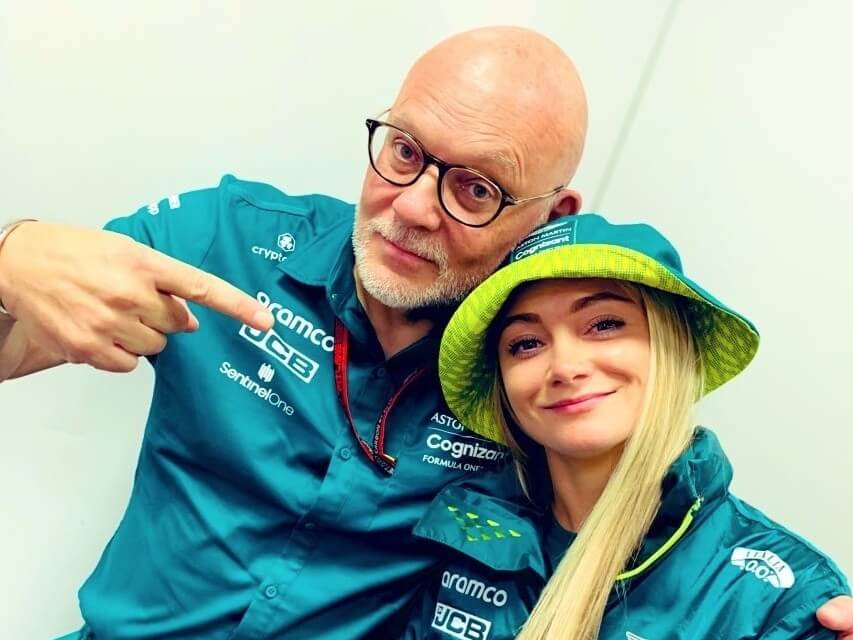
Matt Bishop has spent almost three decades at the heart of Formula 1 and British motorsport. As a prominent figure in motorsport promotion, initially as editor of the groundbreaking F1 Racing magazine before moving into communications for the McLaren and Aston Martin F1 teams, W Series and now the British Touring Car Championship via his Diagonal Comms agency.
As one of the most prominent openly gay figures in the paddock, he has witnessed first-hand how attitudes towards LGBTQ+ people have evolved across the sport. As part of our Pride Month series celebrating LGBTQ+ voices in motorsport, Matt reflects on the progress that’s been made, the challenges that remain, and why he believes motorsport’s future can be more inclusive than ever.
From fan to Formula 1 insider
Matt also has a strong presence as a motor racing historian on social media, MotorSport magazine and through the And Colossally That’s History! podcast with motorsport journalist Richard Williams. “I’ve been a Formula 1 fan since I was a little boy,” he says. “I first entered the paddock probably in the early ’90s when I was working for CAR magazine. When I arrived in 1996 as the editor of F1 Racing magazine, suddenly people took notice of me. I decided that I’m out everywhere, so I’m going to be out in the Formula 1 paddock.”
At the time this was a bold decision, as Matt says: “The world was considerably less accepting than it is now. There were some people who went ‘OK’ and there are other people who were obviously discombobulated by it. I was aware of hearing stories but they rarely said it to my face; everybody else was friendly and judged me on the quality of my work.”
How attitudes have changed
“I think it has got better for people like me; all those ancillary, but important and involved roles, of which there are thousands. I think where it’s still a little bit difficult is for mechanics and engineers, particularly mechanics. The world of motor racing is macho but it’s even more so in their world. This is not a criticism, by the way, they are brilliant people, and they do brilliant work.”
Matt’s status as a trailblazer for the LGBTQ+ community led him to getting anonymous emails, many from mechanics who felt unable to come out to their colleagues, in some case after decades of working together.
Matt says that it can also be tough for young racers in karting and can relate to his own experiences. “It’s hard enough to grow up through life’s challenges as a young teenager, trying to work out who you are, who you fancy,” he explains. “The one who is most surprised is the person themselves; they didn’t know they were gay or bi et cetera until they knew they were, so it’s a discovery for them, let alone for friends and family. It’s doubly hard if they’re trying to become a racing driver at the same time. And you get middle-aged heterosexual men saying to young karters, ‘you drove really gay today, son’.”
Why inclusion makes teams stronger
Matt has worked with karting organisations and Formula 1 teams to try to effect cultural change and through an intelligent approach, has seen positive and lasting results. “[In karting] I thought we might get some pushback,” he says. “By and large they went, ‘that’s interesting, I’d never thought of that. I’ll try and avoid that kind of phrasing in future’, which I thought was quite touching and impressive.
Working with F1 teams Matt appealed to their competitive spirit, using the anonymous emails that he had received as inspiration. The stress of having to hide a double life “is going to cause them to be distracted, upset, and work less well, so it’s ultimately going to make your car slower or less reliable. How about that? Don’t you want to fix it? If you had a really robust and progressive LGBTQ+ inclusion policy, you might eliminate that degree of distraction, and your car might go faster. When you say that to super-competitive Formula 1 people, that gets their attention.”
As with many sports, LGBTQ+ competitors are also reluctant to come out, often only doing so once retired. “I think it is a little bit like the mechanics,” Matt says. “They thought it might make their lives more difficult and perhaps barracking from crowds and on social media. Making a mistake and hitting the wall is embarrassing enough for anybody. Do that if you’ve just come out as gay and X will be a toxic minefield for you.
“But I think the world is changing, [look at] Tom Daley. He decided to come out and the reaction was very positive; now he’s a national treasure. The incidence of LGBTQ+ people embracing serious careers as divers has increased, nobody thinks twice if the Olympic team has got quite a few gay guys in the diving team. It’s the same as women’s tennis and women’s football.”
Looking ahead
“Therefore what if there is someone on the way up and they reach Formula One. Let’s say they come out and they start winning races. Let’s say they win the Monaco Grand Prix for Ferrari and, celebrating, you see him spraying the champagne, and then he gives his boyfriend a hug and a peck on the cheek, and off they go walking down the paddock holding hands. I think people would say ‘good for them’ just like they do with Tom Daley and Dustin Lance Black.
“I actually think you would get big corporates [interested] because [there’s] something else that makes him special. The same would be the case if we had a woman in Formula One; she would become a global megastar, so the world is ready.
Matt is confident that it is a case of when and not if, despite previous attitudes. “The legends of the past, great people were of their era. They certainly didn’t talk about mental health or diversity, equity, and inclusion because it wasn’t of the time to do that. But Lando, Lewis and also Sebastian Vettel talk openly about diversity, equity, and inclusion, including LGBTQ+ rights and they don’t think in any way that it’s impugning their masculinity. The fact that the world is changing has meant that Formula 1 drivers are changing.”
“One of the things I passionately believe is that all forms of motorsport should absolutely be for and welcome absolutely everyone. Try and be welcoming to everyone. If you happen to be in a grandstand, and you hear somebody who obviously belongs to a minority of some kind being bullied, I think sometimes one has to say ‘there’s no need to speak in that way’.”
Matt’s story is a reminder that motorsport is driven by people willing to challenge assumptions in order to make progress. Taking a more inclusive approach is not about changing what makes motorsport great but ensuring more people can discover this as every one of us was a newcomer once. Our challenge now is to make sure that door remains open for the next generation of competitors, volunteers, officials and fans.
Click here for more details of Motorsport UK’s inclusion programmes.