
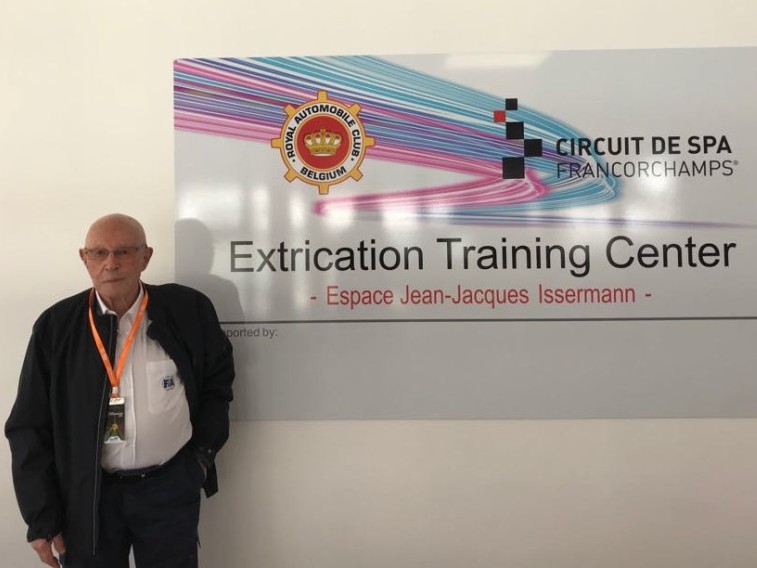
Dr. Jean-Jacques Issermann was a pioneer in motorsport safety and his legacy is one that benefits everyone in the sport.
Born in Paris, he took a job as a General Practitioner for a village close to Le Mans in 1949, coinciding with the first post-war running of the 24-hour race. Hearing the noise of race cars when his train stopped at Arnage station was enough to pique Isserman’s curiosity and the following year he was on duty at Mulsanne during the night.
Isserman became a regular presence at the race even after he moved to Chevilly-Larue, south-west of Paris in 1956. The town was located close to the Montlhéry circuit and he began to compete, in the process adding the historic track to his medical itinerary alongside Le Mans.
The 1950s and 60s was a time of changing attitudes towards safety and Isserman was no stranger to dealing with tragic events at both circuits. After being introduced to Claude Bourillot, then president of the French motorsport federation (FFSA), Isserman began to make a lasting impression on the sport.
Initially working on upgrading medical facilities at French circuits, Isserman also introduced an emergency medical vehicle funded by the Citroën Total Foundation. He then pioneered the practice of a doctor’s car in the 1972 French Grand Prix, asking Vic Elford to take the wheel.
Soon afterwards, Isserman joined the FIA’s newly-created Medical Commission, working with Professor Sid Watkins but it was in the late 1980s that he made his most significant contribution to saving lives in the sport. Asked to help mitigate serious accidents that had affected F1 drivers Philippe Streiff and Emmanuele Pirro, Isserman introduced medical extrication teams and by 1990 they were mandated for all FIA-sanctioned world championship events. This innovation has saved many lives, making motorsport a much safer environment over the last 35 years but many of Dr Isserman’s initiatives have now become common practice, making him a true hero of the sport.